

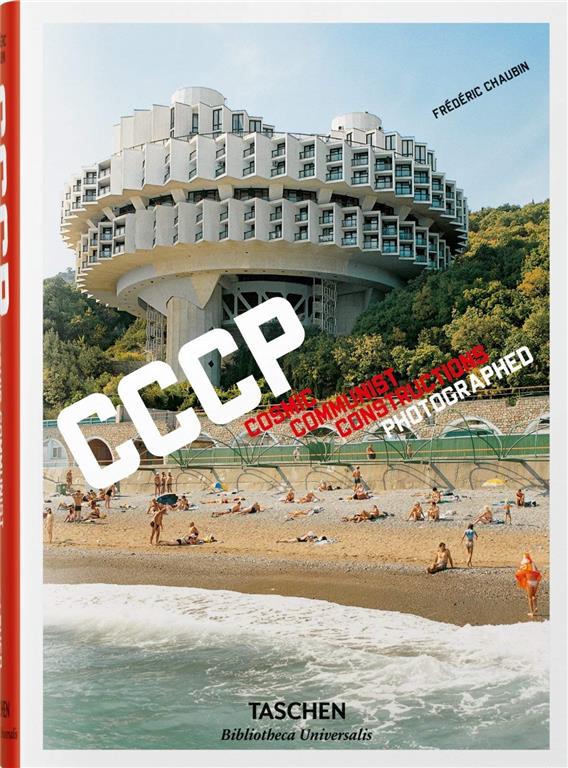
Frédéric Chaubin. CCCP. Cosmic Communist Constructions Photographed

Frédéric Chaubin. CCCP. Cosmic Communist Constructions Photographed
EGP710.00
(2020) Elected the architectural book of the year by the International Artbook and Film Festival in Perpignan, France, Frédéric Chaubin’s Cosmic Communist Constructions Photographed explores 90 buildings in 14 former Soviet Republics. Each of these structures expresses what Chaubin considers the fourth age of Soviet architecture, an unknown burgeoning that took place from 1970 until 1990.
Contrary to the 1920s and 1950s, no “school” or main trend emerges here. These buildings represent a chaotic impulse brought about by a decaying system. Taking advantage of the collapsing monolithic structure, architects went far beyond modernism, going back to the roots or freely innovating. Some of the daring ones completed projects that the Constructivists would have dreamt of (Druzhba Sanatorium, Yalta), others expressed their imagination in an expressionist way (Palace of Weddings, Tbilisi). A summer camp, inspired by sketches of a prototype lunar base, lays claim to Suprematist influence (Prometheus youth camp, Bogatyr). Then comes the “speaking architecture” widespread in the last years of the USSR: a crematorium adorned with concrete flames (Crematorium, Kiev), a technological institute with a flying saucer crashed on the roof (Institute of Scientific Research, Kiev), a political center watching you like Big Brother (House of Soviets, Kaliningrad).
In their puzzle of styles, their outlandish strategies, these buildings are extraordinary remnants of a collapsing system.In their diversity and local exoticism, they testify both to the vast geography of the USSR and its encroaching end of the Soviet Union, the holes in a widening net. At the same time, they immortalize many of the ideological dreams of the country and its time, from an obsession with the cosmos to the rebirth of identity.
Out of stock
Frédéric Chaubin. CCCP. Cosmic Communist Constructions Photographed
Frédéric Chaubin. CCCP. Cosmic Communist Constructions Photographed Book Description
Readers will discover an unusual visual journey in Frédéric Chaubin. CCCP. Cosmic Communist Constructions Photographed, a 2020 English‑language book now available at Kalimat Bookstore Online. The volume was named Architectural Book of the Year by the International Artbook and Film Festival in Perpignan, France. It captures 90 remarkable structures built between 1970 and 1990 across 14 former Soviet republics.
The story explores what Chaubin calls the “fourth age” of Soviet architecture. Unlike the bold avant‑garde of the 1920s or the monumental style of the 1950s, this era shows no single school or trend. Instead, architects reacted to a crumbling system by mixing nostalgia, experimentation, and wild imagination. Consequently, each building feels like a snapshot of a chaotic, decaying world.
Fans of architectural photography will enjoy striking images of daring projects such as the Druzhba Sanatorium in Yalta and the Palace of Weddings in Tbilisi. Meanwhile, the book highlights whimsical works like the Prometheus youth camp, whose design echoes a lunar‑base sketch and Suprematist ideas. These pages reveal how architects both reclaimed modernist roots and forged unpredictable new forms.
Key Features of Frédéric Chaubin. CCCP. Cosmic Communist Constructions Photographed
Inside, readers can explore a diverse collection of “speaking architecture” that emerged in the USSR’s final years. For example, a crematorium in Kiev features concrete flames that seem to speak of loss, while the Institute of Scientific Research in Kiev displays a crashed saucer on its roof. Moreover, the House of Soviets in Kaliningrad watches the city like a modern Big Brother.
Each photograph is accompanied by concise captions that explain the building’s context, design influences, and cultural significance. Additionally, the book maps the geographic spread of these structures, showing how local traditions blended with Soviet ideology. Therefore, the volume serves both as a visual encyclopedia and a cultural commentary.
Moreover, Chaubin’s work captures the ideological dreams of the era—from an obsession with space travel to a yearning for renewed identity. The images immortalize a fleeting moment when optimism, decay, and ambition collided in concrete and steel.
Why Read This Book?
Readers will gain a fresh perspective on a little‑known chapter of architectural history. The book invites you to compare Soviet experimentalism with global trends, making it valuable for students, designers, and history enthusiasts alike. Furthermore, the high‑quality photographs provide inspiration for contemporary architects seeking bold, unconventional ideas.
Fans of visual storytelling will appreciate the seamless blend of art and documentation. Meanwhile, the concise text ensures the experience remains accessible without overwhelming technical jargon. Consequently, the book is an engaging, educational addition to any personal library.
About This Book
More detail about this book and its author can be found on Goodreads. Also, discover the best English books online in our store through this link.
| Author |
|---|
Only logged in customers who have purchased this product may leave a review.
Product Related
Out of stock
EGP3,350.00

Out of stock
EGP385.00
EGP395.00
Out of stock
EGP690.00
Reviews
There are no reviews yet.