

A Short History of Nearly Everything (Bryson)
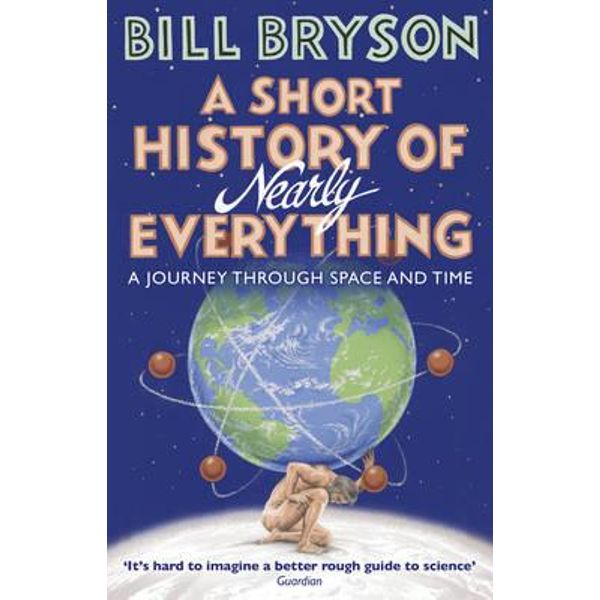


A Short History of Nearly Everything (Bryson)
Book Summary
| Bill Bryson describes himself as a reluctant traveller, but even when he stays safely at home he can’t contain his curiosity about the world around him. A Short History of Nearly Everything is his quest to understand everything that has happened from the Big Bang to the rise of civilization – how we got from there, being nothing at all, to here, being us. Bill Bryson’s challenge is to take subjects that normally bore the pants off most of us, like geology, chemistry and particle physics, and see if there isn’t some way to render them comprehensible to people who have never thought they could be interested in science. The ultimate eye-opening journey through time and space, A Short History of Nearly Everything is the biggest-selling popular science book of the 21st century, and reveals the world in a way most of us have never seen it before. |
Language: English
Paperback: 672 pages
Publisher: Black Swan (2004)
ISBN-10: 9781784161859
ISBN-13: 9781784161859
Genre: History
Size: 12.8 cm x 19.6 cm
Shipping Weight: 110 grams
Condition: New
A Short History of Nearly Everything (Bryson)
A Short History of Nearly Everything (Bryson) Book Description
Readers will discover a curious traveller’s mind in Bill Bryson’s A Short History of Nearly Everything. He admits he is a reluctant explorer, yet his wonder pushes him from the comfort of his home into the vast unknown. The book asks a simple question: how did we go from a silent Big Bang to bustling civilization? Throughout the pages, Bryson turns daunting subjects—geology, chemistry, particle physics—into friendly conversations. Meanwhile, he invites anyone who has never felt at home in a science book to join the adventure.
The story begins with the birth of the universe and walks forward to the rise of humans. Each chapter feels like a short trip, packed with anecdotes, humor, and clear explanations. Because Bryson writes with wit, complex ideas become easy to follow. Moreover, the narrative never feels dry; jokes and everyday comparisons keep the pace lively. Therefore, readers can learn about quarks, continents, and extinct species without feeling overwhelmed.
Fans of popular science will enjoy the balance of facts and storytelling. The author weaves together discoveries from ancient scholars to modern laboratories. Additionally, the book highlights the personalities behind breakthroughs, showing that curiosity drives progress. Consequently, the text feels personal, not just a list of dates and formulas. Readers can appreciate how tiny atoms shape massive mountains, and how a single mistake once threatened our understanding of the cosmos.
Key Features of A Short History of Nearly Everything
Inside this 672‑page paperback, Bryson offers more than a timeline. He provides vivid illustrations of the Earth’s formation, the chemistry of our atmosphere, and the physics that govern stars. The language stays simple, allowing readers of all ages to grasp the concepts. Furthermore, each chapter ends with a short recap, helping the mind retain key points.
The book’s size—12.8 cm × 19.6 cm—makes it easy to hold while traveling or lounging at home. Its lightweight design (110 g) ensures it won’t weigh down a bag. Moreover, the new condition guarantees crisp pages and a clean cover, perfect for gifting or personal study.
Published by Black Swan in 2004, the edition carries ISBN‑10 9781784161859 and ISBN‑13 9781784161859. It falls under the History genre, yet it reads like a thrilling adventure. Also, the author’s humor adds a unique flavor that sets this work apart from typical science textbooks.
Why Read This Book?
Many readers seek a bridge between curiosity and knowledge. This book builds that bridge by turning dry data into engaging stories. Readers will gain a deeper appreciation for the universe while enjoying an entertaining read. Because Bryson explains why each discovery matters, the book inspires further exploration in science, history, and philosophy.
Moreover, the popularity of A Short History of Nearly Everything proves its impact. It remains the best‑selling popular science title of the 21st century. Therefore, buying it adds a proven classic to any collection. Additionally, the book encourages discussions about our place in the cosmos, making it a great choice for book clubs and classrooms.
About This Book
In A Short History of Nearly Everything (Bryson), curiosity meets clarity. Bill Bryson invites readers on an eye‑opening journey through time and space, revealing a world most of us have never truly seen. The blend of humor, facts, and accessible language makes learning feel like an adventure. Whether you are a lifelong science fan or a newcomer, this book promises to broaden your horizons and spark endless questions about the universe.
| Author |
|---|
Only logged in customers who have purchased this product may leave a review.
Product Related

Out of stock
EGP495.00

EGP550.00

Out of stock

EGP50.00
Reviews
There are no reviews yet.